Highlights · Stop 5 of 6
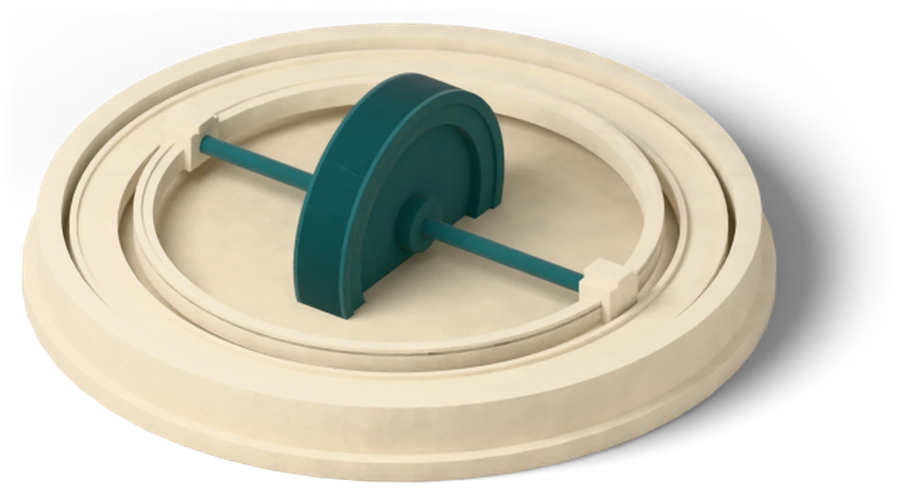
Exhibit JT-0518 · Level 5
Gyrocompass
Share via
A spinning gyroscope finds north without a magnetic field.
A rapidly spinning rotor holds its axis fixed in space. If the axis is constrained to stay horizontal, the Earth's rotation slowly turns it into the north-south line. Léon Foucault demonstrated both effects in 1852 and named the instrument a gyroscope, from Greek words for rotation and seeing. He had already shown the Earth's rotation in 1851 with a pendulum like the one on Level 1.
In a gyrocompass the centre of gravity sits below the point of suspension. When the axis tilts, gravity produces a torque that steers it towards true geographic north. This directive force is strongest at the equator and falls to zero at the poles.
On warships, steel walls and armour plating hampered the magnetic compass. In 1901 Hermann Anschütz-Kaempfe even planned to reach the North Pole by submarine. For this he developed a gyrocompass, which his company built in Kiel. In March 1908 the instrument ran for four weeks without a break aboard the naval ship Deutschland. When Elmer Sperry brought out a rival gyrocompass, Anschütz-Kaempfe sued for patent infringement in 1914. The court appointed Albert Einstein as an expert witness, and Anschütz-Kaempfe won the case. Einstein later helped develop the sphere compass, whose gyros sit inside a sealed sphere. For an idea of his own he received licence fees for many years.
Listen
No magnet. Just a spinning top, always pointing north. That is how ships find their way.
Topics
PhysicsNavigationinteractive
Ask the museum
Did you notice something? Do you have a question about this exhibit? Write it here — the museum reads along.