Highlights · Stop 2 of 6
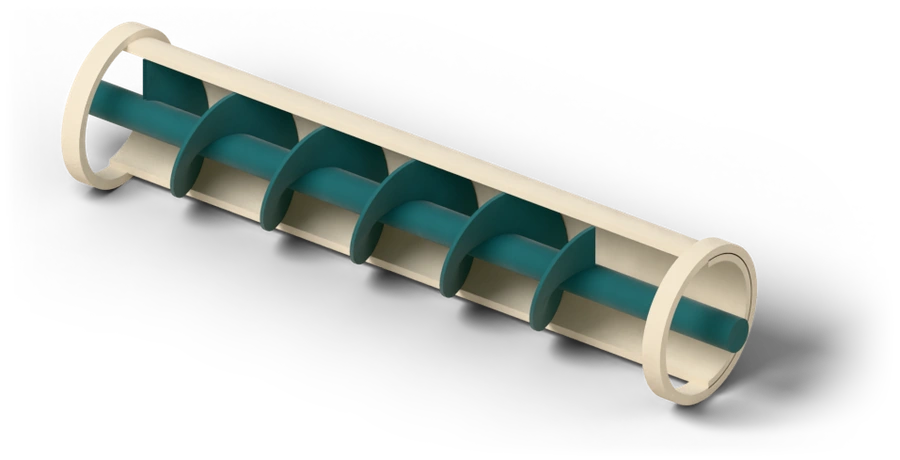
Exhibit 1.7.E3 · Level 1
Archimedes Screw
Share via
This screw moves water uphill — invented more than 2,000 years ago.
Show on the floor planAn Archimedes screw is a shaft carrying a helical blade, set at an angle inside a tube or trough. When its lower end dips into water and the screw turns, each winding scoops up a portion of water. Trapped between the blades, the water climbs with every rotation until it spills out at the top. The steeper it is set, the less water it delivers.
In Greek it was called kochlias, the snail. Writing in the first century BC, the historian Diodorus of Sicily credited Archimedes of Syracuse (c. 287–212 BC) with its invention. His work records that it was used to irrigate the Nile Delta and to pump water out of silver mines in Spain. Ancient images show a person standing on treads fixed to the barrel, turning the screw with their feet. Historians of technology such as John Peter Oleson regard Archimedes as the inventor. Others believe he found it already in use in Egypt. The Assyriologist Stephanie Dalley has suggested it was known in Assyria as early as the seventh century BC, though this is disputed. Screw pumps built on the same principle lift wastewater at sewage treatment plants today.
Listen
Water running uphill! Sounds impossible — but turn the crank, and the screw carries it up. Devised more than two thousand years ago.
Watch
Description of the film (no spoken words): A pencil drawing comes to life. On the bank of a small stream stands an Archimedean screw: a long, inclined wooden trough with a spiral blade around a shaft, its lower end in the water, its upper end at a wooden channel. A man in a hat and light shirt steps up and turns the crank at the top. With each turn, water travels up the spiral and pours out of the top of the screw into the channel — a steady stream lifted uphill.
Topics
AntiquityMachinesinteractive
Ask the museum
Did you notice something? Do you have a question about this exhibit? Write it here — the museum reads along.