Highlights · Stop 3 of 6
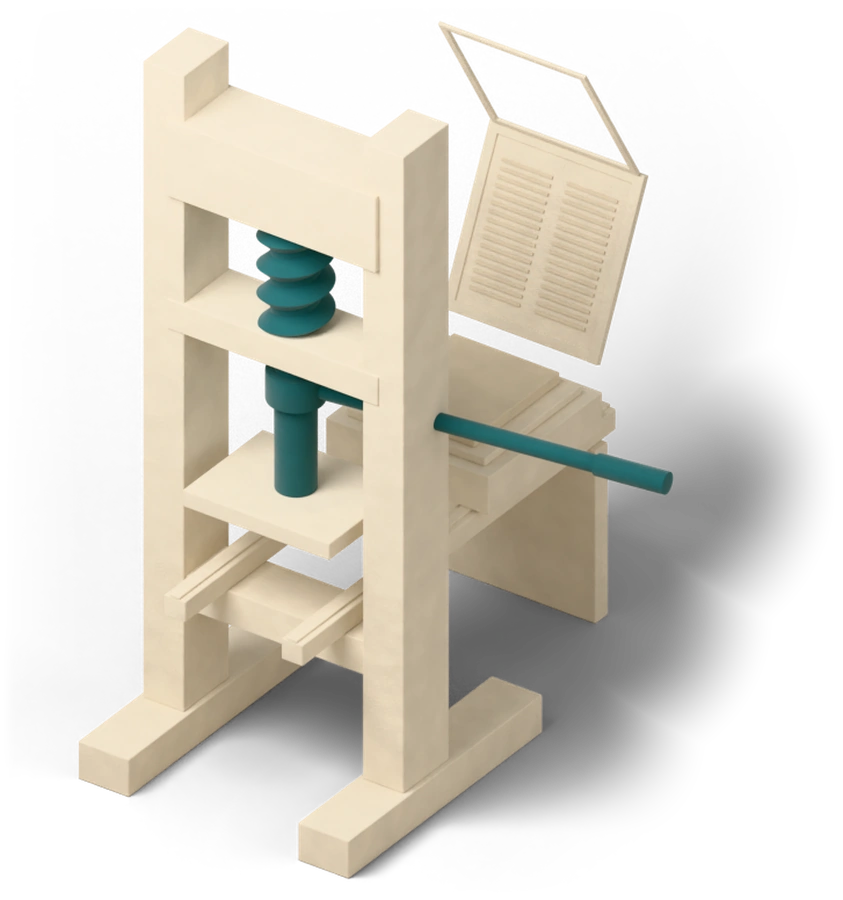
Exhibit JT-0307 · Level 3
Gutenberg Printing Press
Share via
Printing with movable type changed the way knowledge spreads.
Gutenberg developed his press in Mainz around 1450. He probably modelled it on wine or paper presses, but in those the pressing plate turns with the screw, which would have smeared the ink. A small intermediate piece keeps the platen from turning. Gutenberg's own press has not survived. Reconstructions show how printing worked: the type is inked with ink balls, and the paper sits in a hinged cover. A firm pull on the bar lowers the screw and presses the sheet evenly onto the type.
The real breakthrough was the hand mould. It could cast identical letters in large numbers, probably mainly from lead, tin and antimony. Gutenberg paired it with an oil-based ink of soot and linseed-oil varnish, since water-based inks transferred poorly from metal type.
Around 290 different characters were cast for the Gutenberg Bible. Some 180 copies were printed in about two years, of which 49 survive. By 1500, printers across Europe had produced tens of thousands of editions. Movable metal type was not new, though: a book had been printed with it in Korea in 1377.
Listen
Copying a Bible by hand often took more than a year. Gutenberg's workshop printed around a hundred and eighty in about two years. That changed everything.
Watch
Description of the film (no spoken words): A pencil drawing comes to life. A printer in a hat and apron stands at a wooden press with a screw and lever. He dabs ink onto the type in the form with a round leather ball, lays a sheet of paper into the open frame, closes it and pulls the lever — the platen presses the paper onto the type. Then he opens the frame and carefully lifts off the freshly printed page.
Topics
CommunicationNeuzeit
Ask the museum
Did you notice something? Do you have a question about this exhibit? Write it here — the museum reads along.