Demo: School class tour – pendulum, gyroscope and printing · Stop 1 of 3
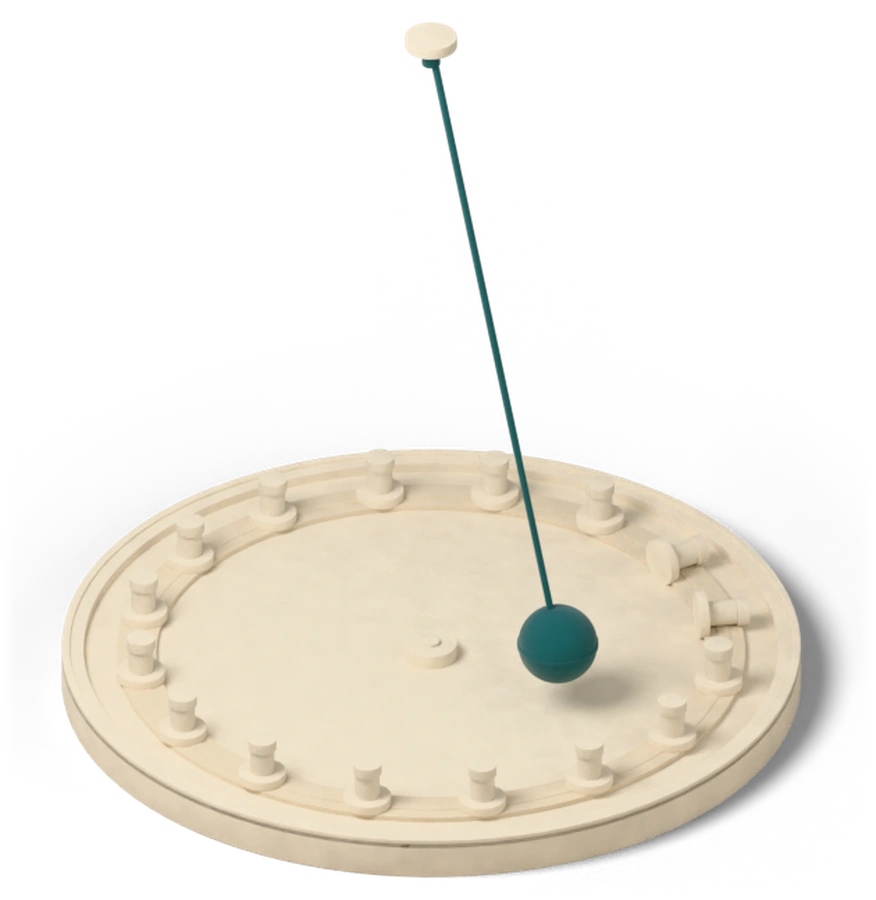
Exhibit 1.26.E5 · Level 1
Foucault's Pendulum
Share via
A pendulum that makes the rotation of the Earth visible.
Show on the floor planLéon Foucault first tested his idea in January 1851 with a two-metre pendulum in his cellar, then at the Paris Observatory with an eleven-metre wire. The grand public demonstration followed that March in the Panthéon. There, a lead-filled brass sphere weighing 28 kilograms swung from a 67-metre wire, and a stylus on the bob left marks in sand.
A heavy, compact bob is slowed less by air resistance. With the longer wire at the Observatory, Foucault reported, the pendulum swung more slowly and more widely, which made the deviation easier to see. To start it, he describes a simple trick: a loop of thread holds the sphere against the wall until it is completely at rest. Then the thread is burned through, and the pendulum sets off without any push.
Scientists at the time no longer doubted that the Earth rotates. The pendulum, however, made that rotation visible to anyone in an experiment. Within months it was being repeated in many cities across Europe and the United States. In 1852 Foucault developed a second device to show the same effect: the gyroscope.
Drawings
Listen
Look closely. The pendulum always swings the same way — but the floor turns beneath it. What you are seeing is the Earth itself.
Watch the pendulum for a while. It always swings straight, back and forth. And yet after an hour, its path points in a slightly different direction. The pendulum has not turned. The floor beneath it has, and with it the whole Earth. Léon Foucault demonstrated this in Paris in 1851. How fast the path moves depends on where the pendulum hangs. At the North Pole, it completes a full circle in just under twenty-four hours. At the equator, the path does not move at all. Here in Magdeburg, a full rotation takes about thirty hours.
Topics
PhysicsAstronomyinteractive
Ask the museum
Did you notice something? Do you have a question about this exhibit? Write it here — the museum reads along.